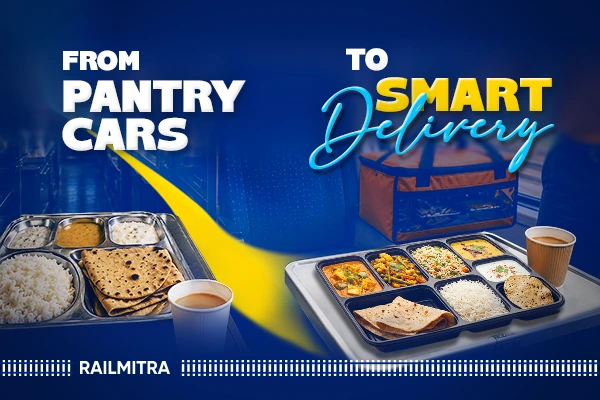
Indian Railways has undergone a lot of changes since the first steam engine brought the train from Bombay to Thane. Passengers slowly started trusting this service and it became a mainstay of travel of the common folks. Food also became a crucial part of the journey. It has evolved from the local station hawkers, to the railway providing its own panty car to the recent breakthrough for food delivery in trains.

Passengers’ concerns initially were about the connectivity. However, slowly the comfort and experience of the journey started becoming more and more important. As a result of this Indian Railways has undergone a huge technological upgrade not only regarding train amenities but also train food delivery options. Let’s take a detailed look on how all of this unfolded.
The Early Days: Station Refreshment Rooms and Vendors
Railway kitchens in India did not start on trains. Stations came first. Colonial-era refreshment rooms opened at major junctions, mainly for European travellers. Bread, roast chicken, tea. A menu built for a particular kind of passenger and nobody else, really.
Vendors stepped in for everyone and the refreshment rooms ignored. They ran alongside slowing trains, passing samosas and chai and roasted corn through carriage windows. Out of nowhere, crowds swarmed platform edges when trains arrived – people reaching through open windows while voices cracked through the air hawking snacks. Goods shifted between strangers mid-motion, steam still rising under metal wheels. Starting around the turn of the last century’s turn, officials began tagging approved merchants with official marks. Success looked different depending where you stood and what year it was.
Howrah, Victoria Terminus, Lahore: by the early 1900s these had proper station dining. First and second class passengers mostly. The food was better organized, the facilities were cleaner, and the prices matched who the railway expected to be sitting there. Third class, which covered the bulk of Indian rail travel, ran on tiffin boxes brought from home and whatever the platform vendor happened to be carrying. Nobody built that system for them. They just worked around it.
Pantry Cars: The Railway Kitchen on Wheels
Somewhere in the mid-twentieth century, a carriage got converted into a moving kitchen. The pantry car. Cooking equipment on board, staff to carry food through the train, meals available without waiting for a platform stop. For long-distance routes with few major junctions along the way, it addressed a real problem.
What it created was a different problem. The pantry car operator had a locked-in audience with no exit option. Cold food, inflated prices, whatever quality the contractor felt like delivering that week: a passenger on a 36-hour journey had no leverage. Railway Ministry files and parliamentary questions from the 1970s through the 2000s are full of pantry car complaints. The food safety issues got documented repeatedly. Not much changed.
Attempts at reform came in waves. Contracts got centralized. Menus got standardized. Prices got capped, at least on paper. Things improved in spots, stayed bad in others. The core issue was structural: one kitchen per train, no competition, no choice.
Express and Rajdhani Trains: Meals as Part of the Ticket
Back in 1969, the Rajdhani Express began running between New Delhi and Howrah, including food right in the ticket price. A paper menu came into view once onboard, meals arrived on schedule, while everything felt far better arranged compared to typical Indian rail journeys of that time. For 1969, it worked.
Shatabdi came in 1988 with the same logic for day journeys: tea, snacks, meals included. Shorter routes, simpler menus, tighter service windows. The model held up reasonably well on those trains specifically.
Both still run this way. The caterers have changed hands several times, gone back to centralized control, been handed to private operators again. Food safety checks on these trains over the years have turned up inconsistent results. The included-meal model on Rajdhani and Shatabdi is not the problem it once was on the older pantry car trains, but it is not without its own issues either.
If you are traveling on either, check live train status before you board. Meal service windows on a 20-plus hour Rajdhani run depend on the train actually being on time, and on long routes the difference of two hours matters.
Superfast and Mail Express Trains: Where E-Catering Changed Things
On train food services and pantry cars are still in operation, however the scene has been gradually shifting since a major change in 2014. The incoming of the e-catering on trains.
This system was started by the national rail booking platform where passengers can choose a station for food delivery. They just have to select the restaurants from the station, pick meals and make the payment. The food will be delivered once the chosen station arrives.
No flagging down a vendor. No settling for whatever the pantry car cooked that morning.
A train food app like RailMitra takes this further. One spot holds every detail: menus, delivery times, where your order sits now. Near big stops such as Prayagraj, Bhopal, Nagpur, Vijayawada, choices stretch out long – you weigh street-style thalis against rich biryani, maybe grab a burger instead of waiting on pantry meals that might taste flat.
Jan Shatabdi and Intercity Trains: Vendor Trolleys and Not Much Else
Jan Shatabdi and intercity express trains are shorter-distance services, usually four to eight hours, and their food situation reflects that. Vendor trolleys move through the coaches. Packaged snacks, chai, the occasional basic meal. Whether anything is available two hours in depends on which vendors were licensed at which stations that day, and nobody tells the passenger this in advance.
On busy routes like Patna to Ranchi or Delhi to Dehradun the vendor presence is fairly consistent. On thinner routes there can be long stretches with nothing coming through. No pantry car, no guaranteed onboard service.Passengers who are adapted to this condition neither try to find, nor are they able to find any options once they cross Kanpur.
Train food delivery with the help of online platforms like RailMitra is slowly changing this. Some stations are still uncovered but with the presence of more than 500 stations across the country we are slowly covering all the gaps. When on busy routes, always check from RailMitra whether they deliver food on your station or not. More often than not your answer will be in the affirmative.
Vande Bharat Trains: No Pantry Car, Fixed Menu, Still Some Gaps
From 2019 onward, Vande Bharat Express skipped the pantry car entirely. Instead of cooking meals fresh during travel, food service relies on a compact kitchen space onboard. Pre-packed dishes get warmed up before serving, not made from raw ingredients mid-journey. Morning trains get breakfast. Evening departures get snacks and tea. The fare includes it.
The packaging improved. Hygiene complaints, which were a staple of pantry car coverage for decades, largely dropped off for Vande Bharat. What passengers complain about now is variety and quantity. Those are smaller problems, even if they feel frustrating on a journey.
Passengers who want something regional or something outside the standard menu can still use e-catering at major stops on Vande Bharat routes. For anyone avoiding non-veg food, pure veg food in train is bookable through RailMitra, with restaurant partners whose kitchens carry certified vegetarian status.
Food Delivery in Train for Group Travel
Feeding a group on a train has always been awkward. Eight family members, a school party, an office trip: individual pantry car orders for everyone meant eight separate interactions with the trolley vendor, someone always wanting something the trolley did not have, and no real way to consolidate. The pantry car staff were not set up for group custom orders, and the vendor was not going to wait while a family of ten made up their minds.
E-catering helped but the bigger fix was group ordering. A group order through RailMitra pulls multiple passengers in the same coach or booking into a single order from one restaurant at one delivery stop. One food delivery in train, not eight. Coordination simplifies when orders combine. Costs often drop – hitting the minimum feels almost automatic. Families riding overnight in 3A or 2A coaches tend to eat this way now. Dinner just works better like this.
Why RailMitra for Food Delivery in Train
The pantry car story is essentially a 70-year story of a monopoly that passengers could not escape. You were on the train. The pantry car was on the train. That was your food.
Food Delivery in Train through RailMitra is what actually broke that structure, at least on routes where restaurant coverage is available. The passenger now picks the kitchen, picks the restaurant, picks the city the food is coming from. RailMitra lists verified partners across major junctions, handles the order, and coordinates delivery timed to your train’s arrival at that station.
The one thing that makes or breaks a delivery is whether the train is actually on time. Check live train status on RailMitra before your delivery station comes up. If the train is running late by two or more hours, the restaurant needs notice and the order window may shift. Getting that wrong means either cold food or a missed delivery.
The pantry car will keep running on trains and routes where there is no e-catering alternative. But on the routes where RailMitra operates, passengers have been choosing ordered food over pantry car food in increasing numbers. The numbers do not lie about which one people prefer when they have the option.
Conclusion
Railway food in India went from station refreshment rooms built for colonial officers to pantry cars that passengers complained about for half a century to, now, an app where you order from a restaurant three cities away and eat it in your seat. Food Delivery in Train through RailMitra is the newest version of that chain, and the reason it is growing is simple: given a choice between a captive pantry car and a restaurant you actually picked yourself, most passengers pick the restaurant.