Look up trains between any two major cities and you will often find one entry sitting slightly apart from the rest. Higher fare. A note about complimentary meals. Maybe an “IRCTC operated” tag. That is the Tejas Express. Not one train exactly, but a brand: India’s attempt at semi-high-speed, airline-style rail travel on routes that actually have demand. This guide covers the Tejas Express properly. What the train actually is, what you pay, how the seat classes differ, and what the food situation looks like in practice.

Before you finalize travel dates, check Train Schedule for days of operation and halt stations since not all Tejas services run daily.
What Is the Tejas Express
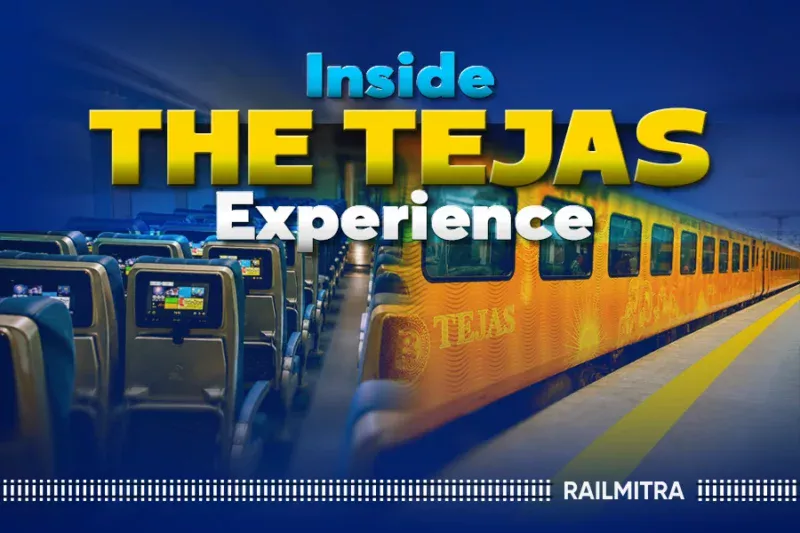
“Tejas” translates roughly to brilliance or sharpness across several Indian languages. Indian Railways built the Tejas Express brand around one idea: take what makes a budget airline tolerable and put it on a train. Automatic doors that will not open while the train is moving, onboard Wi-Fi, CCTV in every coach, bio-vacuum toilets. A fire detection and suppression system came with it too. First time that had ever been standard-fit on a regular passenger service in India.
The coaches themselves are LHB stainless-steel, coming out of either Kapurthala or Chennai depending on the rake. On paper the design allows 200 km/h. In practice, most corridors cap it between 130 and 160 because the track simply does not support more yet.
On the train, a system called PICCU keeps track of things while you ride. Instead of waiting for failure, sensors watch how bearings and wheels are doing every second. Temperature shifts, air quality changes – especially carbon dioxide levels – are checked nonstop. When numbers begin to slip outside normal ranges, warnings pop up instantly. Maintenance teams get those signals right away, long before any part gives out. Filters in heating and cooling units? They’re watched too. Problems show early, so fixes happen quietly, behind the scenes. Not visible to the passenger at all. Mostly just explains why Tejas tends to ride more consistently than older rakes on the same kind of long haul.
Tejas Express Routes by Region
Four regions, fairly different character in each.
Western Region Trains
Take 22119/22120 first, Mumbai CSMT all the way down to Madgaon in Goa. Konkan Railway, roughly 580 km, runs five days a week. October to February is when it gets serious about selling out, sometimes past what the declared capacity is supposed to allow.
82901/82902 is the Ahmedabad-Mumbai Central run, six days a week. Business traffic is what it was built around. Surat, Vadodara, Vapi are the stops, useful enough that people do same-day corporate trips and come back the same evening. Both these services run under IRCTC. Leaving home without checking Live Train Status first could ruin your travel plans. Picture arriving at the platform only to find delays already in motion. Better wait outside than rush into confusion inside. Staying ahead means fewer surprises later on. Knowing takes less time than explaining why you’re late.
| Train No. | Route | Distance | Frequency |
| 22119/22120 | Mumbai CSMT to Madgaon | 580 km | 5 days/week |
| 82901/82902 | Ahmedabad to Mumbai Central | 492 km | 6 days/week |
Northern Region Trains
82501/82502 between Lucknow NE and New Delhi gets talked about more than most Tejas services, mostly because it was India’s first privately operated train when it launched. IRCTC runs it, six days a week, 512 km. On this stretch, the delay situation has been noticeably better than what regular expresses tend to deliver, though festive season is its own story.
12309/12310 is Rajendra Nagar Patna to New Delhi, daily, 1001 km, Tejas rakes since the upgrade. 20501/20502 runs Agartala to Anand Vihar once a week, 2423 km. Tripura did not have anything in the premium overnight category before this came in.
| Train No. | Route | Distance | Frequency |
| 82501/82502 | Lucknow NE to New Delhi | 512 km | 6 days/week |
| 12309/12310 | Rajendra Nagar (Patna) to New Delhi | 1001 km | Daily |
| 20501/20502 | Agartala to Anand Vihar | 2423 km | Weekly |
Southern Region Trains
22671/22672, Chennai Egmore to Madurai. Six days a week, 493 km. Around 80 km/h average on this corridor. That figure only starts to land properly when you have spent time on the older mail expresses that used to cover the same ground. The EC menu here runs Paneer Chettinad, which is not something you find on the standard rotation that most other Tejas trains cycle through.
| Train No. | Route | Distance | Frequency |
| 22671/22672 | Chennai Egmore to Madurai | 493 km | 6 days/week |
Eastern Region Trains
Odisha to New Delhi is not one Tejas Rajdhani, it is three. Heading out from Sambalpur, Adra, or Tatanagar means paths spread wide across the region. One traveler in Sambalpur might name a certain train – someone else in Bhubaneswar could just as easily say another.
| Train No. | Route | Distance | Frequency |
| 20817/20818 | Bhubaneswar to New Delhi (via Sambalpur) | 1914 km | Weekly |
| 22811/22812 | Bhubaneswar to New Delhi (via Adra) | 1730 km | Bi-weekly |
| 22823/22824 | Bhubaneswar to New Delhi (via Tatanagar) | 1801 km | 4 days/week |
Seat Classes: CC vs EC
Two classes. Both air-conditioned.
AC Chair Car (CC)
3×2 layout, somewhere between 72 and 78 seats per coach depending on the rake. Eco-leather on fire-resistant foam. Snack tray folds down from the seat in front, luggage goes overhead or under the seat, reading light is individual. Early Tejas rakes had LCD screens in the seatbacks. That was dropped; the 4G Wi-Fi on board is supposed to cover it, and it mostly does on populated corridors.
Executive Chair Car (EC)
2×2 layout, 56 seats. Anyone who has done both CC and EC on a journey over two hours will tell you the legroom difference is not subtle. The seat rotation draws the most comments: 180 degrees, so you can sit facing the direction of travel, reverse it, or angle toward the person across from you if you are travelling with someone. Calf rests and footrests are built in, USB charging is in the armrest, attendant call button is there too. Premium headphones and a wider newspaper selection on most routes.
| Feature | CC | EC |
| Layout | 3×2 | 2×2 |
| Capacity per coach | 72 to 78 | 56 |
| Seat rotation | Fixed | 180 degrees |
| Leg support | None | Calf rest and footrest |
| Fare tier | Standard premium | Higher |
For live availability before booking, Train Seat Availability covers both CC and EC.
Fare Structure and Dynamic Pricing
Starting point: Tejas fares run about 20 to 30 percent higher than Shatabdi on comparable chair car travel. And unlike Shatabdi, pricing is not fixed.
One out of ten seats goes for the starting price. After those are taken, every new chunk of ten percent fills at a higher level – each round lifts cost by one tenth more than before. This step-by-step rise keeps going until prices reach half again what they began at. Book early and you pay the least. Leave it a week before travel and the seat costs noticeably more than it would have in October for a December journey.
| Seats Sold | Fare |
| 0 to 10% | Base fare |
| 11 to 20% | Base + 10% |
| 21 to 30% | Base + 20% |
| 31 to 40% | Base + 30% |
| 41 to 50% | Base + 40% |
| Above 50% | Base + 50% (cap) |
Lucknow-Delhi Tejas fares have crossed Rs. 4,000 on Diwali dates in some years. A last-minute flight on that same corridor is not always that much more. IRCTC maintains that even at peak, Tejas fares stay around 50 percent below equivalent air tickets, which tends to hold.
One thing worth knowing before booking: Tejas gives nobody a concession. Not senior citizens. Not students. No VIP quota either. A child above five pays what an adult pays.
Delay Compensation
More than one hour late and IRCTC automatically credits compensation into the passenger’s account. Rs. 100 for Chair Car. Rs. 250 for Executive Class. No TDR. Nothing to file.
Every Tejas ticket also comes with free rail travel insurance up to Rs. 25 lakh, with Rs. 1 lakh specifically for theft or robbery during travel.
Once booked, use PNR Status to confirm coach and berth allotment.
Food on Tejas Express
What the Onboard Pantry Covers
Complimentary meals are included in the ticket on most Tejas routes. What gets served depends on when the train runs.
Breakfast: veg cutlets with poha, medu vada with suji upma, masala omelette on the non-veg side. Branded dahi and fruit juice alongside. Lunch, then dinner: dal tadka shows up alongside Kashmiri pulao, laccha paranthas join in, while paneer or chicken tikka masala takes center stage. When winter settles, gulab jamun appears – sometimes moong dal halwa instead. Heat arrives? Ice cream follows.
Shorter routes hold up reasonably well on pantry quality. Long-distance Tejas Rajdhani is a different matter. Dinner specifically has drawn complaints on overnight runs, and that is where e-catering starts to make practical sense.
Ordering Food via RailMitra
If you don’t want to try the same boring food of a pantry car, book food in train through the RailMitra website or train food app. Food through RailMitra comes with the help of more than 2,500 partners, all of which are FSSAI approved. These services are present in more than 500 stations.
The food ordering process is very simple. Just enter your PNR number and all the train and seat details will be detected by the system. If you don’t have the PNR number you can also order by entering your train name or number. After entering the train number, please enter your boarding date and station.
The system will provide all the stations that have train food delivery. Just pick the station, you want and select from the available restaurants. Add the meals of your choice and head on to the payment section.
The part that actually matters: RailMitra syncs delivery timing with actual train running status. If the Tejas is delayed by 45 minutes, the restaurant gets that update and prepares accordingly. Food arrives hot because it was prepared around your actual arrival, not the scheduled one.
Jain food, diabetic meals, toddler portions: all available here. The onboard pantry handles none of those.
Regional ordering is worth doing if the route passes through stations that have decent options on the platform. Pyaaz Kachori at Kota Junction. Fafda-Jalebi or Thepla somewhere along the Gujarat stretch. Misal Pav once you hit Maharashtra. Litti Chokha or Sattu Paratha if you are on a Northern service passing through Patna Junction. Groups can pre-book days ahead with bulk discounts coming in on larger orders.
| Feature | RailMitra | Onboard Pantry |
| Options | 2,500+ restaurants | Fixed cyclic menu |
| Customisation | Jain, diabetic, toddler | Limited |
| Delivery | Seat delivery | Trolley in aisle |
| Delay sync | Yes, automatic | Fixed prep schedule |
Tejas vs Vande Bharat: Where Things Are Heading
Vande Bharat runs without a locomotive. It is an EMU, self-propelled, which means acceleration and braking happen faster than what the locomotive-hauled LHB Tejas setup allows. The pace of deployment on major corridors caught a lot of people off guard honestly.
What that has meant for Tejas: the rakes are going into Rajdhani upgrades now more than new Tejas-branded routes. Mumbai Rajdhani, Patna Rajdhani, a few others. Air suspension bogies and noise insulation are what passengers actually notice when they board one of these upgraded overnight trains compared to the older rakes they replaced.
Vande Bharat Sleeper variants are coming, automatic climate control, better insulation, shower cubicles in first class. That changes the overnight premium picture significantly once they arrive. Until then, on corridors where Vande Bharat has not shown up yet, Tejas is still the premium option sitting under flight prices.
Conclusion
Most Indian Railways passengers have a reference point for express trains. The Tejas Express sits outside that reference point. Automatic doors, real-time coach diagnostics, fire suppression built in, 180-degree rotating seats in EC, delay compensation that credits itself without any TDR: none of these are features you get on a standard service. Pay more, lose all concessions, book early or pay the dynamic pricing penalty.
For food, the RailMitra option has made long Tejas journeys genuinely better. The onboard pantry handles short runs fine. On overnight routes, having fresh regional food ordered to your seat with delivery timed to the train’s actual running, not the scheduled arrival, is worth using rather than skipping.